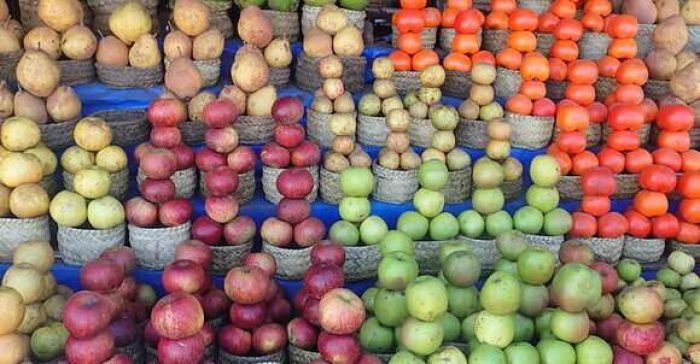
Tropical fruits
Madagascar is a country rich in fruit production. Most fruit species are found there, including tropical, semi-tropical (bananas, lychees, mangoes, citrus fruits, pineapples, papayas), temperate (apples, pears, peaches, plums, strawberries, etc.), and exotic (grapes, pok-pok, melons, coconuts). Overall, the fruit export structure is limited to wild harvesting, estimated at 801,000 metric tons of production (in the case of mangoes), and the cultivation of a few trees, equivalent to 151,000 metric tons of production (citrus fruits, persimmons, peaches, etc.). Some fruits are nevertheless cultivated industrially, such as apple trees, but they only constitute 51,000 metric tons of production. In general, temperate fruits are found mainly in the Highlands, while semi-tropical and tropical fruits are located on the east coast, in the northwest, and in the north. The main recipient countries of fresh Malagasy fruit are the sister islands of Réunion and Mauritius, and France. There is strong demand from the United States for exotic products. Generally, prices paid to producers are low. The fruit sector suffers primarily from insufficient inputs for fertilization and phytosanitary treatments, resulting in low productivity, as most orchards are outdated. The main exported fruit is the lychee: the Toamasina orchard accounts for 43,771 metric tons of national production, followed by Fianarantsoa with 32,591 metric tons. With an annual production of around 100,000 tons of lychees, Madagascar is the third largest producer in the world after China and India. Between 16,000 and 20,000 tons are exported fresh to the European Union each year during the Christmas season.
The cocoa bean
Madagascar's cocoa is among the best in the world, with organoleptic characteristics highly prized by leading chocolatiers. The Sambirano Valley in the north is the main production area. Cocoa from this region is among the most sought-after on the high-end market. This quality is linked to the soil characteristics, the cocoa variety, and especially the harvesting practices (ripe pods) and post-harvest processing (fermentation and drying). In April 2015, the Group of Cocoa Stakeholders of Madagascar (GACM) was created, comprising producers, chocolatiers, and operators/exporters. Madagascar also joined the International Cocoa Organization (ICCO) in 2016. With the support of the
According to the World Bank, several activities have been undertaken to improve the quality, traceability, and sustainability standards of the sector. As a result, between 2015 and 2018, export volumes increased by nearly 601 metric tons (TP3T) to reach almost 12,000 tons, of which more than 901 TP3T met international standards. The government aims to establish partnerships with major cocoa-producing countries, such as Côte d'Ivoire, particularly for skills transfer, in order to increase domestic production. Malagasy cocoa is the only one in Africa to hold the "fine cocoa" designation, according to the ICCO, even though Madagascar ranks only 20th among producing countries. The sector is also attracting new investments in cocoa processing facilities. The National Cocoa Plan, approved in 2018, now guides all activities aimed at ensuring the sustainability of the value chain.
Urban agriculture
Long practiced in Antananarivo and its surrounding areas, small-scale agriculture remains crucial for the capital's food security. The hills are well-suited to market gardening. According to a report by members of the National Institute of Agronomic Research (INRA) and the Center for International Cooperation in Agricultural Research for Development (CIRAD), a gradual loss of agricultural land, amounting to 61,000 hectares (61,300 tons), was observed between 2002 and 2016, primarily due to land reclamation. However, the city's rice-growing plain is holding up well. The urban commune comprises 361,000 hectares (361,300 tons) of agricultural land, and Greater Antananarivo, encompassing 37 surrounding communes, forms a green belt with nearly 501,000 hectares (501,300 tons) of cultivated land. This green belt provides the local population with 121,000 to 181,000 tons of rice and 801,000 tons (801,300 tons) of tomatoes. Other sectors, such as poultry farming, have developed. Chicken farms and egg production now supply 90% of the Tananarivian market.