


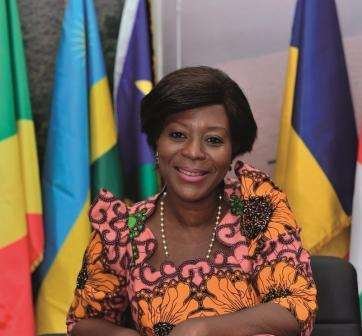
Interview with Arlette Soudan-Nonault, Minister of the Environment, Sustainable Development and the Congo Basin since May 15, 2021, who is committed to mobilizing the international community towards real actions in the fight against climate change in Africa.
As the technical coordinator of the Congo Basin Climate Commission, you are preparing for the Summit of the three largest forest basins in the world. What are your concrete expectations for this event?
The central objective of the "Amazon/Borneo-Southeast Asia and Mekong/Congo Summit, Summit of the Three Basins of Biodiversity Ecosystems and Tropical Forests," to be held in Brazzaville on October 26, 27, and 28, is to establish, through the union of the three basins, a global alliance of biodiversity ecosystems and tropical forests. This alliance/coalition, governed strictly by South-South cooperation, will structure the three global ecosystems that represent 801,000 tons of tropical forests worldwide, encompass two-thirds of terrestrial biodiversity, and play a vital role as global regulators of carbon balance and life on Earth. The three basins are expected to capture 801,000 tons of the existing and future financial commitments announced at COP27 for climate and COP15 for biodiversity. This global alliance of the three basins will constitute a legitimate force for proposals and negotiations within multilateral climate and biodiversity bodies.
The Summit aims to achieve six strategic objectives:
– to define and adopt the outlines of a global governance scheme through a cooperation agreement between the three basins and the formation of a global alliance of the three basins; ;
– to develop a common strategy, with a work program and a portfolio of investment projects in order to anticipate and prepare funding requests from existing and future financing mechanisms; ;
– sign financing agreements with multilateral and bilateral donors, global philanthropy and develop financial mechanisms with the private sector, including the creation of a sovereign carbon market to ensure sustainable financing for the three basins; ;
– to create a sub-regional and intercontinental scientific and technical cooperation platform and to strengthen capacities in the three sub-regions; ;
– to break down the silos between climate and biodiversity issues, which are closely linked at the scale of ecosystemic problems, and to reconcile environmental law from the Kunming-Montreal Agreement and climate law from the Paris Agreement; ;
– to establish a legitimate and leading organization for proposing and negotiating within multilateral climate and biodiversity bodies. Achieving these objectives requires the adoption in Brazzaville of guidelines that structure the political and strategic vision of the Alliance/Coalition of the three basins. The founding principles of these guidelines will be adopted by stakeholders at the Summit and will be the subject of a declaration by the Heads of State and Government of the three basins. It is therefore essential that these principles and the documents defining them be subject to broad consultation with all stakeholders in the three basins in order to obtain their input, support, and approval, thereby ensuring their implementation and success.
Should North-South cooperation be revived? Is the participation of the European Union important?
North-South cooperation seems essential to achieving the objectives of the Paris Agreement, particularly limiting the temperature rise to 1.5 degrees Celsius. Commitments from the more polluting northern countries to the more successful southern countries in terms of mitigation, and therefore less polluting, have not yet been honored. It is worth noting that the "Amazon/Borneo-Southeast Asia and Mekong/Congo Summit, Summit of the Three Basins of Biodiversity Ecosystems and Tropical Forests" will bring together several categories of participants, including financial partners: Fortune 500 companies and philanthropic organizations; multilateral donors; and financial markets, whose support is necessary for the successful organization of the Summit. The participation of the European Union is important and will take place through the scientific community, which will be represented by members of the Intergovernmental Panel on Climate Change (IPCC), the Intergovernmental Science-Policy Platform on Biodiversity and Ecosystem Services (IPBES) and national climate and biodiversity experts from the States involved (such as the French department of French Guiana, which is part of the Amazon basin), as well as representatives of research and training institutions on tropical forests located in North America (Canada and USA), Europe, Asia, Australia and New Zealand.
In the Congo Basin, who should receive carbon credits? Projects or countries?
Climate change is accelerating and pressure is mounting on countries and businesses for the effective implementation of the Paris Climate Agreement.
The demand for carbon credits from African countries is becoming increasingly urgent. Africa and its private sector are not benefiting at all from the carbon market. Yet, despite being home to the world's second largest carbon sink and vast carbon-absorbing and storage ecosystems (forests, mangroves, and peatlands), Africa currently receives only 111 TP3T of global carbon offsets.
The Congo Basin, with its vast tropical rainforests, sits atop an economic goldmine, a green windfall thanks to its largely untapped carbon credit potential. To this end, these countries should benefit from both carbon offsets and carbon credits. Hence the development by the Economic Commission for Africa of the standardized and harmonized protocol on greenhouse gases to promote the integrity of the carbon market and investments related to climate-resilient economic activities in the member countries of the Congo Basin Climate Commission. In most carbon projects, the revenues generated from the sale of carbon credits are shared equitably among the beneficiaries (the project developer, local communities, and, where possible, the State). This sharing is based on the principles defined within the framework of the benefit-sharing mechanism.
What is your strategy regarding the Nationally Determined Contribution (NDC)?
The Republic of Congo, in accordance with the provisions of the Paris Agreement ratified on April 21, 2017, had revised its first NDC in 2021 and submitted the revised document to the Secretariat of the United Nations Framework Convention on Climate Change (UNFCCC) on August 2, 2021.
The Republic of Congo, although part of the group of developing countries with low greenhouse gas emissions, intends to contribute to the global effort by raising its ambition in the fight against climate change.
The strategy adopted for the revision of this NDC was based on 5 pillars:
– Strengthening the political will and commitment of national stakeholders and development partners; ;
– The review, alignment and updating of objectives, policies and measures established in the areas of climate and sustainable development; ;
– The integration of new sectors and/or greenhouse gases into the revised NDC; ;
– The assessment of the costs and investment opportunities of the priority actions selected in the areas of climate and sustainable development; ;
– Monitoring progress and strengthening transparency.
The Republic of Congo improved its NDC by expanding the scope of sectors covered by mitigation measures and adding the forestry sector, which had not been included in the previous submission in 2015. The sectors included were:
– energy with the sub-sectors of energy production; ;
– transport; ;
– households and services; ;
– industrial processes and use of products (PIUP); ;
– agriculture; ;
– forestry and other land uses; ;
– waste.
According to the revised NDC, the greenhouse gas (GHG) emission reduction target is 56,911 TEUs in 2025 and 54,661 TEUs in 2030, of which 51,691 TEUs and 47,501 TEUs respectively require international support (conditional scenario). With support from the French Development Agency (AFD) through the Adapt'Action program, the Republic of Congo developed an action plan in December 2022 to implement the revised NDC. This action plan includes mitigation measures; mitigation and adaptation measures for the forestry and other land-use (FLU) sector; adaptation measures; and cross-cutting measures.
As you can see, the Republic of Congo, a very low emitter of greenhouse gases, is doing more than its share in the global fight against climate change. Our demand for climate justice is therefore all the more justified.