


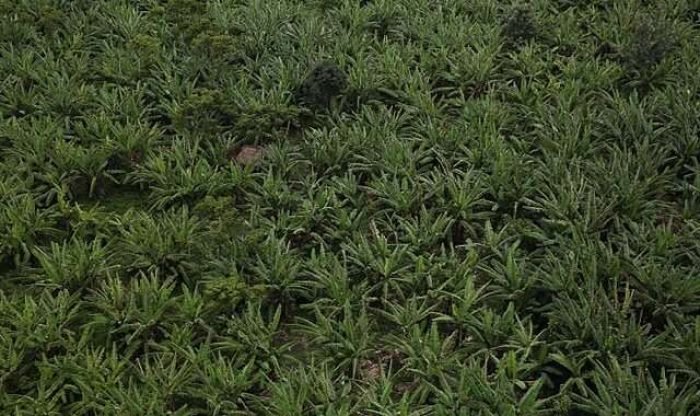
The Congo Basin offers favorable climatic conditions for the cultivation of oil palm, rubber, coffee, cocoa, banana and cassava, while the savannah areas are favorable for the cultivation of cotton, cereals, and legumes; the mountainous areas, where a relatively temperate climate prevails, are suitable for highland crops such as coffee, tea, and potatoes.
Food crops
The rise in wheat prices, the main imported cereal, particularly to meet urban demand, has spurred substitution with other cereals considered "second-tier" (notably sorghum and millet) or tubers like cassava. The DRC has thus adopted a plan to promote the use of cassava flour to meet the demand for processed cereal-based food products such as pastries. Soybeans are a miracle crop for combating malnutrition and balancing cassava-based diets.
An agricultural investment company, Logix Africa SAS, aims to modernize agriculture and produce 30,000 tons of maize and 15,000 tons of soybeans in the Democratic Republic of Congo (DRC). While the country has significant development potential, agricultural production has stagnated since independence. The agricultural sector faces challenges, particularly in accessing quality agricultural inputs and tools. Logix addresses this gap by providing farmers and agricultural entrepreneurs with equipment and machinery, seeds, pesticides, and biofertilizers, all under the guidance of qualified technical support.
Located southeast of the capital, Kinshasa, the Bukanga Lonzo agro-industrial park covers 83,000 hectares. Established through a partnership between the DRC government and a group of South African companies, it is currently under the supervision of the National Ministry of Agriculture. Eighteen different crops are cultivated there, including maize, cassava, savannah rice, various vegetables, and livestock farming.
The production of market gardeners and perennials
The Congolese cocoa and coffee sectors are undergoing a major transformation, focusing on quality to increase added value. This resurgence is largely due to support provided by NGOs and bilateral cooperation initiatives with producers, and is accompanied, beyond increased volumes, by a new vision for cultivation. Particular attention is being paid to certification (organic and fair trade) and the marketing of specialty coffees and cocoas. For cocoa cultivation, the DRC has six times more arable land than Côte d'Ivoire, the world's leading producer and exporter of cocoa. Today, production is largely carried out by thousands of smallholder farmers organized into cooperatives, the largest of which, Solidarité Paysanne pour la Promotion des Actions Café et Développement Intégral (Sopacdi), in South Kivu, has 12,000 members.